Two tests, two different questions
Hair Loss Analysis & Epigenetic Hair Scans in Fort Collins
The scalp tells you what. The rest of you tells you why.
Thinning hair has a cause, and it is rarely the one people guess. This is magnified analysis of the scalp by a hair loss specialist, paired with an optional epigenetic hair scan that looks at the internal picture — nutrient patterns, stress load and environmental factors that show up alongside hair and scalp change.
Book a scalp evaluation Call (970) 698-6800
60 minutes · in studio · the scan is optional and priced separately
Two different questions
They are often confused, and they answer different things. Most people need the first. Some people want the second as well.
Where the scan fits, honestly
It explains why a scalp that looks fine is behaving badly, and it points at the things worth taking to your doctor with evidence in hand. What it is and what it is not is set out in plain terms further down this page.
What gets measured
- Follicle densityFollicular units per square centimeter, in the same marked zones each visit.
- Hairs per follicleHow many strands each follicle is still producing.
- Hair thicknessWhat proportion of hairs are thinning rather than falling.
- Sebum, moisture and scalp heatMeasured with a Courage + Khazaka Skin Diagnostic unit.
- Sensitivity and flakingThe condition of the skin the hair grows out of.
- The last twelve monthsHealth, stress, medication, nutrition — usually the explanation.
What actually happens
The word “scan” makes people picture bloodwork. It is not that.
A few hairs, taken at the root
Four strands from the back of the head, with the root bulb attached. Nothing is drawn, nothing is injected, and it does not hurt.
Sent to the lab, and read
Hair strands with the root attached go to Cell Wellbeing’s data center in Hamburg, where they are read against a reference database covering more than 800 nutritional and environmental factors.
What comes back
A report of 37 pages and a six-step 90-day plan, with every indicator marked Priority, Advisory or Consider — then a 30-minute call to go through it properly.
What the scan looks at
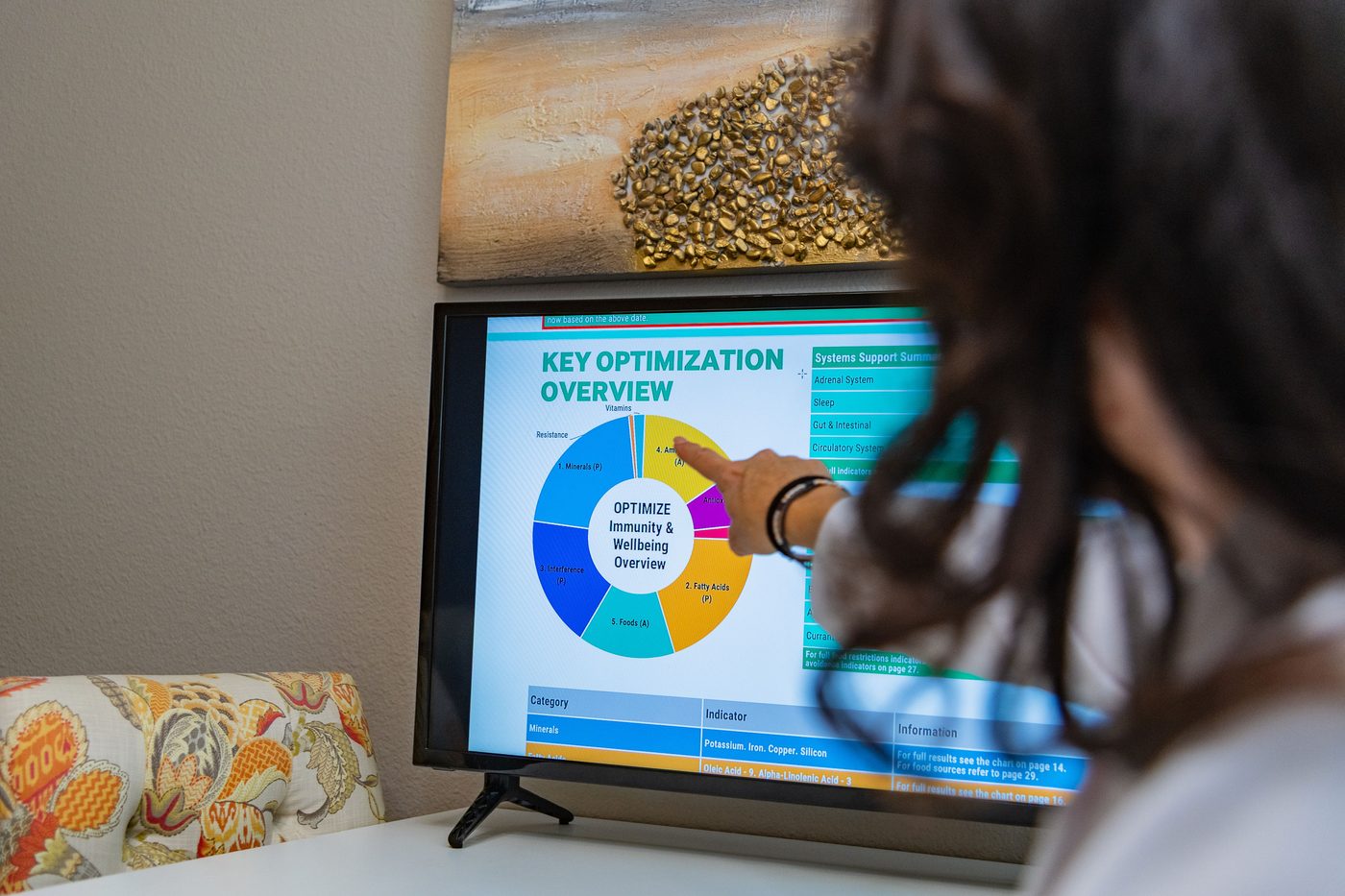
The internal side of the picture — read by a trichologist alongside the scalp findings, never on its own.
- Amino acids and fatty acidsHair is protein. The building blocks show up first.
- Essential vitamins and mineralsIron, zinc and the B group are the ones that most often matter for hair.
- Antioxidant balanceWhere oxidative load sits against what the body is countering it with.
- Gut and immune stressorsAbsorption matters as much as intake. Nutrients eaten but not taken up never reach the follicle.
- Environmental loadCumulative exposure patterns, read as a general picture rather than a specific finding.
- Metabolic patternsHow the body is currently prioritizing energy. Hair sits near the bottom of that list.
$225, including the report and a 30-minute follow-up call to go through it. The plan runs 90 days, with a self-check at day 1, 30, 60 and 90, because that is the window Cell Wellbeing considers the report valid for. It usually follows the scalp evaluation rather than replacing it.
Why it is called epigenetic, and why that is not a DNA test
These get confused constantly, and the difference is the whole point of the scan.
The blueprint you were born with
Genetic variants are essentially fixed. Run the same test in ten years and you get the same answer, because that is what the test is measuring.
What is influencing you right now
It looks at current nutritional and environmental influences — the ones that move with diet, stress, sleep and environment. Scan again in six months and the priorities can be different. That is not your DNA changing; it is a different set of present-day influences.
The plan runs 90 days
If the inputs are what shift, the sensible thing is to change them for a set period and then look again, rather than treat one report as a permanent verdict.
The questions people actually ask
What do you need from me?
A few hairs from the back of the head, with the bulb attached. It takes a moment, it does not hurt, and there is no bloodwork and no needle.
Is this an allergy test or a food sensitivity test?
No. It is neither, and it cannot be. Allergy and food-sensitivity testing is medical testing, done by a physician using validated methods, and a hair sample cannot substitute for it. If you think you have an allergy or an intolerance, see a doctor — and be wary of anyone selling a hair test as one.
The report does list foods and additives to ease off for the 90 days. Cell Wellbeing states it in capitals on that page of their own report: this is not a food allergy test, and the food indicators are not a physical intolerance or allergy. Known allergies must still be avoided always, and the restriction list is a short-term nutritional priority, nothing more.
How accurate is it?
It is a wellness screening rather than a medical test. It points at patterns worth looking into, and several of those are things a doctor can confirm properly with bloodwork.
Do I have to have it?
No. The scalp evaluation stands on its own and most people start there. The scan is an optional add-on for when the scalp findings point inward and the question becomes why.
Many clients begin with the clinical scalp evaluation before moving into deeper hair loss analysis.
The other test
The HALO genetic test
The scan reads what is influencing you now. HALO reads what you inherited. They are different samples, different questions, and they are most useful together.
A cheek swab
Thirty seconds inside each cheek, after half an hour of nothing to eat or drink. No hair, no blood, no needle.
34 variants across 30 genes
Fagron Genomics evaluates inherited differences relevant to hair loss, treatment response, scalp health, nutrient use and recovery.
Read as pathways, not trivia
Findings are grouped into biological pathways rather than listed one by one, because a single variant means little without the ones around it.
$650. Offered under Fagron’s physician licensing. Amy Gray is not a prescriber — the report’s medication layer is information for a physician, and anything in that territory is referred out.
What HALO looks at
Four categories, in Fagron’s own structure.
- Anti-alopecicsProstaglandin signaling, minoxidil activation, androgen and DHT metabolism, glucocorticoid response.
- Skin and scalp supportCirculation, collagen integrity and growth-factor signaling — ACE, COL1A1, IGF1R.
- Oxidative stress and detoxificationHow well cells handle oxidative load and clear damaging compounds — NRF2, antioxidant defense, glutathione.
- Hair, aesthetics and longevityMicrobiome and barrier function, wound healing, cellular energy, tissue strength.
Twelve of the variants sit in vitamin and mineral pathways — vitamin D, biotin, B9, B12, vitamin C, vitamin E, iron, zinc, magnesium and selenium among them.
What comes back, and what it is not
HALO returns recommendations across five categories: pharmacogenetics, nutraceutical support, in-office modalities, topical biologics and home care. Each pathway is weighted low, moderate or high, which sets how intensive a plan needs to be rather than how severe anything is.
It does not diagnose anything
Fagron’s own guidance is to use the results to inform supportive treatment selection, not to diagnose a current scalp condition. The findings do not independently establish poor circulation, collagen deficiency or impaired growth signaling — clinical findings and your history are still what determine whether any of that is actually happening.
The result does not change
Unlike the scan, this is the blueprint. Run it once. If it is done, it does not need doing again, and a second opinion on the same DNA will say the same thing.
It does not replace the evaluation
Genetics says where you may be vulnerable. The scalp evaluation says what is happening on your head today. Neither answers the other’s question, and the plan comes from putting them together.
IgG food sensitivity testing
Offered in specific circumstances only, and worth being straight about.
When it is run
Only when a client is having severe, ongoing reactions — never as a routine part of a hair loss plan and never as a first step. It is ordered through Equi.life and follows their protocol and their licensing.
What the allergy bodies say about it
You should know this before deciding. The American Academy of Allergy, Asthma & Immunology, the European Academy of Allergy and Clinical Immunology and others do not support IgG testing for diagnosing food allergy or intolerance. Their position is that IgG antibodies indicate exposure to a food rather than a reaction against it.
Why it is here at all
Some practitioners use an IgG panel to structure a short elimination and reintroduction trial, where the value comes from the trial rather than from the number on the report. That is the only way it is used here, and it is a conversation rather than a product.
Conditions this is used for
The thinning and shedding patterns this analysis is used to understand. Where findings point to something that needs a physician, you are told that, and told why.
Start with the analysis
Sixty minutes in Fort Collins. You leave with the findings written down, and a clear answer about whether the scan is worth adding.